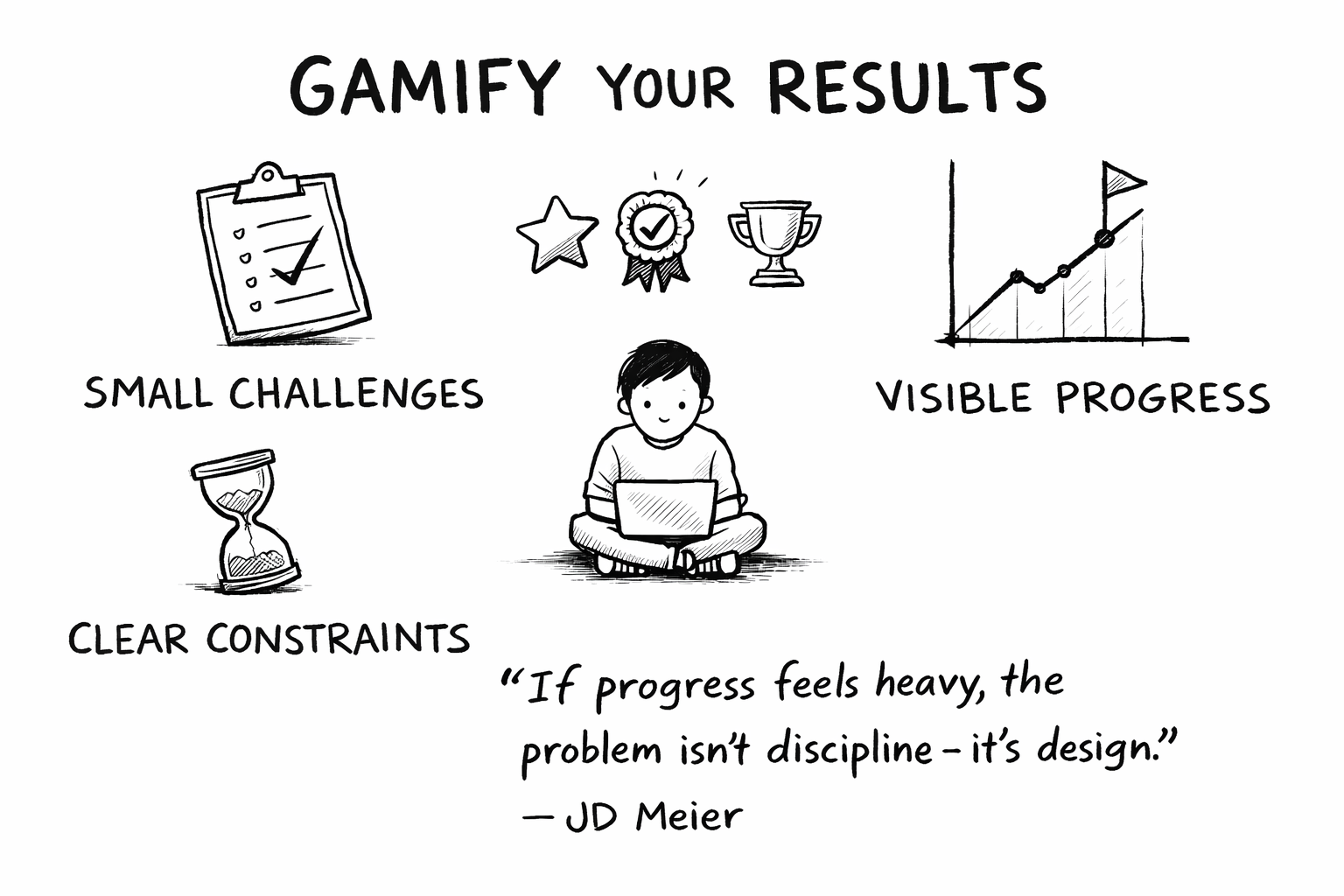
“If progress feels heavy, the problem isn’t discipline — it’s design.”
— JD Meier
Most people think productivity problems require more discipline.
More grit.
More pressure.
More willpower.
In reality, most productivity problems are engagement problems.
If work feels heavy, vague, or endless, motivation collapses — even when the work matters.
Gamification fixes that, not by making work silly, but by making progress visible and rewarding.
What It Means to Gamify Your Results
Gamifying your results doesn’t mean turning work into a video game.
It means applying a few simple game principles to real work:
-
Clear objectives
-
Small challenges
-
Fast feedback
-
Visible progress
-
Meaningful wins
Games work because they keep people engaged, not because they’re easy.
Why Gamification Works
Games naturally solve the problems that stall productivity:
-
They reduce overwhelm
-
They lower the cost of starting
-
They reward progress, not perfection
-
They create momentum
When progress feels attainable, people keep going.
Gamification turns effort into forward motion.
The Core Rules of Gamifying Your Results
You don’t need points, badges, or leaderboards.
You need structure.
Here are the rules that matter.
1. Turn Outcomes Into Challenges
Instead of:
“Work on the presentation”
Try:
“Create 3 headline options in 15 minutes.”
Challenges:
-
Create focus
-
Shrink scope
-
Make starting easier
A clear challenge beats a vague task every time.
2. Play in Short Rounds
Long, open-ended work kills engagement.
Short rounds create urgency without stress.
This is why practices like 20-Minute Sprints work so well:
-
There’s a clear start
-
There’s a clear end
-
You don’t have to pace yourself
You just play the round.
3. Track Progress Visibly
Games keep score.
So should you.
Visible progress:
-
Builds motivation
-
Creates momentum
-
Makes effort feel worthwhile
This can be as simple as:
-
Checking off completed rounds
-
Counting ideas generated
-
Tracking streaks of focused sessions
What gets tracked gets repeated.
4. Reward Completion, Not Perfection
Games reward finishing levels — not perfect execution.
Gamifying your results means:
-
Celebrating drafts
-
Valuing output over polish
-
Moving forward instead of refining endlessly
Progress beats perfection.
5. Add Constraints to Raise the Game
Games are fun because they have limits.
Time limits.
Move limits.
Rule limits.
Constraints:
-
Increase focus
-
Sharpen decisions
-
Prevent overthinking
The right constraints don’t reduce creativity — they activate it.
Gamification Is Especially Powerful for Creative Work
Creative work often stalls because:
-
The work feels too big
-
The outcome feels undefined
-
The finish line feels far away
Gamification solves this by:
-
Breaking creation into rounds
-
Turning ideas into small wins
-
Making experimentation safe
This is why gamification pairs so well with:
-
Creativity
-
Flow
-
The Fun Factor
Examples of Gamifying Your Results
Here are simple, real ways people apply this:
-
“Generate 5 rough ideas — no judging.”
-
“Write for 20 minutes, then stop.”
-
“Improve this draft by 10%.”
-
“Ship one imperfect version today.”
-
“See how much I can finish before the timer ends.”
None of this requires more motivation — just better structure.
Gamification Is About Energy, Not Entertainment
The goal isn’t fun for fun’s sake.
The goal is engagement.
Gamification:
-
Reduces friction
-
Preserves energy
-
Keeps work moving
-
Makes consistency possible
That’s why it’s a core practice in Getting Results.
Try This Today
Pick one task and turn it into a game:
-
Define one small outcome
-
Set a short time limit
-
Track progress visibly
-
Stop when the round ends
Then reset and play another round later.
You’ll be surprised how much easier it feels to start — and to finish.
The Bottom Line
You don’t need to push harder.
You need to engage better.
Gamify your results, and work stops feeling like something you endure
and starts feeling like something you move through.
Progress accelerates when work becomes a game worth playing.

 Creativity and Contraints