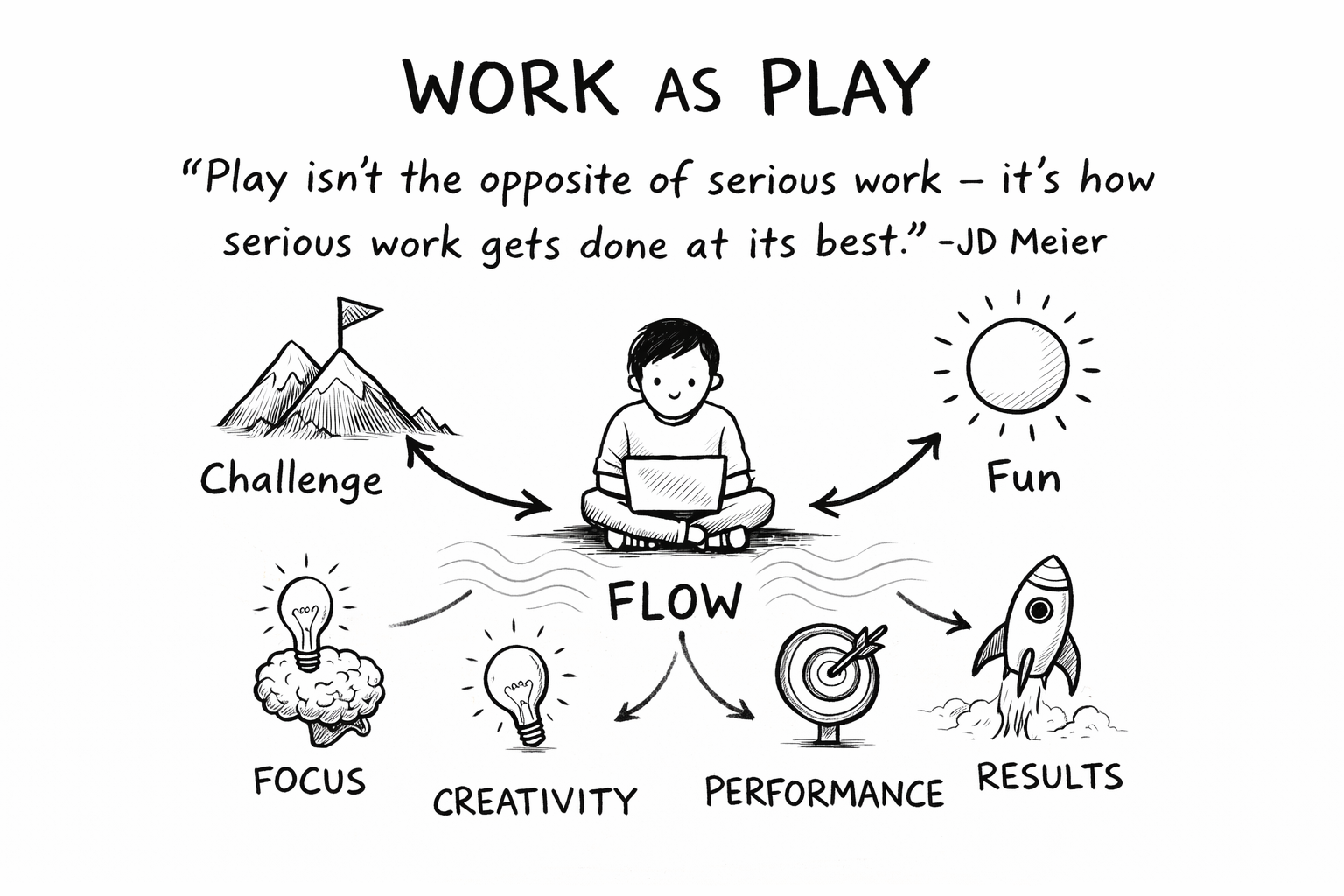
“Play isn’t the opposite of serious work — it’s how serious work gets done at its best.”
— JD Meier
“Work as play” is a mindset and approach that transforms your mandatory tasks into intrinsically enjoyable, engaging, and creative activities.
You can draw on principles like gamification, finding passion, and inspiring flow states to humanize your work.
By shifting your perspective, you can find joy and purpose in your work, approaching it with curiosity, freedom, and a sense of challenge rather than drudgery.
How I Learned Work as Play at Microsoft
I spent years at Microsoft working on hard problems and hardcore challenges.
Complex systems.
High-stakes launches.
Multi-million-dollar projects.
I was used to the tough stuff.
And somewhere along the way, I convinced myself that tough work required serious mode. Heavy problems needed heavy energy.
Then a friend changed everything with one observation.
The Wake-Up Call
I was sharing my Life Hot Spots framework — a way I map out what energizes me across different areas of life.
My friend looked at it and said:
“You’re missing Fun.”
That landed harder than it should have.
He was right. I had optimized for meaning, impact, and mastery — but I had designed fun right out of my work life. I was treating multi-million-dollar projects like burdens to bear instead of adventures to live.
That realization changed how I worked — and how I performed.
The Artificial Wall Between Work and Play
Alan Watts saw something most of us miss:
The division between work and play is a cultural invention.
We’re taught:
-
Work is strenuous effort for money
-
Play is leisure for enjoyment
-
The two shouldn’t mix
Watts called this a source of deep dissatisfaction.
We grind through work to earn the right to enjoy ourselves later. But later keeps moving. And work stays joyless.
His challenge was simple and radical:
What if any task — even strenuous, necessary ones — could be approached as play?
What Play Actually Means
Play is not the opposite of hard work.
Play is any activity that is its own reward.
When you’re playing, you’re not doing the thing to get somewhere else. You’re in it. The process itself matters.
Watts described this as “making music” out of your responsibilities.
Same notes.
Same difficulty.
Completely different relationship.
The Inner Game of Performance
Here’s what high performers often get wrong:
We think intensity produces results.
Sports psychology tells a different story.
In The Inner Game of Tennis, Tim Gallwey showed that peak performance happens when you quiet the internal commentator — the voice that over-analyzes every move.
Watts understood this intuitively.
When you remove the pressure to be serious, performance improves.
The body knows what to do.
The mind gets out of the way.
Seriousness creates interference.
Play creates flow.
The Science (For Skeptics)
The idea of work as play is often misunderstood as frivolous.
Research suggests the opposite.
Play activates learning and memory
-
Playful states activate the brain’s reward system and release dopamine, which tags experiences as “important,” improving learning and retention.
-
Positive emotional states broaden attention and enable more flexible, creative thinking than threat-based or stress-heavy states.
Relaxed alertness beats grind
-
Neuroscience studies of creativity show that low to moderate arousal (“relaxed alertness”) produces more creative neural patterns than high-strain effort.
-
Grinding harder feels productive, but often reduces creative and executive function.
Play reduces threat and improves executive function
-
When tasks are framed as enjoyable challenges rather than threats, defensive brain circuits quiet down and prefrontal regions regain capacity for planning, problem solving, and self-control.
-
This “safe challenge” state is a key condition for flow.
Play at work reduces burnout
-
Workplace studies link play with lower fatigue, boredom, stress, and burnout, alongside higher job satisfaction and creativity.
-
Researchers compare play deprivation to sleep deprivation in its negative impact on well-being and resilience.
Play improves engagement and results
-
Gamified or playful training environments show:
-
~60% higher engagement
-
~40% better skill retention
-
-
In one large professional-services firm, introducing gamified training correlated with:
-
~25% increase in fee collection
-
~22% increase in new business opportunities
-
Play strengthens teams
-
Playful interaction increases trust, bonding, and psychological safety.
-
Teams that incorporate play often outperform “serious” teams on creativity and output due to higher engagement and reduced perceived effort.
In short: play is not an escape from work.
It is one of the most effective ways the brain learns hard things and sustains high performance.
Extreme Play and Innovation
Computer scientist Alan Kay took this further.
He called his approach “extreme play.”
The most transformative innovations don’t come from following rules. They come from playful exploration that questions everything.
Kay didn’t build Smalltalk by grinding. He treated computing as a creative medium.
Curiosity over compliance.
Exploration over execution.
The biggest breakthroughs often emerge from play — not pressure.
The Shift: Three Mental Moves
1. Pretend you chose it
Whatever you’re doing right now, act as if you chose it intentionally.
Watts taught this move. When you treat the moment as your choice, you shift from victim to author.
2. Make it an epic adventure
I reframed my toughest projects this way.
Same complexity.
Same stakes.
Different energy.
A quest creates creativity.
A chore creates resistance.
3. Add the Fun Factor
Audit your work.
Where did you design the enjoyment out?
What would it look like to put it back in?
How to Practice Work as Play
Start small.
-
Pick one task today and ask: “How would I approach this if it were a game?”
-
Notice your energy. When work feels heavy, it’s usually not the task — it’s your relationship to it.
-
Remove the commentator. Stop judging mid-task. Trust the rhythm.
-
Reframe the stakes. High stakes don’t require heavy energy. Elite performers stay loose.
-
Engage your senses. Design an environment you enjoy working in.
-
Celebrate the process. Don’t wait for the finish line to enjoy the work.
The Invitation
Work as play isn’t about making work less serious.
It’s about making you less serious while doing serious work.
The problems don’t get smaller.
But you get lighter.
And paradoxically, that’s when your best work shows up.
What would change if you treated your biggest challenge right now as an epic adventure?
