
“Spectacular success is precedented by unspectacular planning.” — Sharran Srivatsaa
It’s too easy for get overwhelmed and have a bunch of ideas and actions swirling like chaos in your mind.
Aside from overwhelmed, all your undone things and new ideas can eat at you and keep you up at night.
You need an action plan and you need it now.
Sharran Srivatsaa shares a 12-minute method for getting ideas out of your head into an action plan.
Sharran says this method is above and beyond your daily call of duty.
It’s to help you make game changing actions. The ones that get your off the treadmill. The ones that make your work and life, easier.
And more effective.
A Confused Mind Stalls
The big reason for getting things out of your head and down on to paper so you can plan is because a confused mind stalls.
You can think better when you can see and organize your ideas better so you can prioritize, focus, and act on them.
Here’s how Sharran puts it:
“You already have a consumed and confused mind and it will stall.
The brain is to process and think.
When we start to store these ideas it causes stress.
The brain is to process and think, not to store ideas.
As you manage to process and think, you’ll have memory and recall
Spectacular success is preceded by unspectacular planning.”
Think of Your Actions Together Like a Jigsaw Puzzle
One thing at a time doesn’t work when you need to plan your actions for more synergy vs. forking your energy and focus.
Think of your actions together like a jigsaw puzzle.
If you just try to do one piece at a time, or a piecemeal approach, you can’t figure out what’s relevant and what’s important.
It takes the context of the whole to recognize the value and create synergy of the parts.
Here’s how Sharran puts it:
“Have you ever done a jigsaw puzzle?
You can’t take one piece out of the box at a time and then try to build the puzzle.
Most coaches and consultants try to take one piece at a time.
Take this one piece and focus on this piece, take this piece and focus on the next piece.
You need the other pieces to figure out whether that’s relevant or not, whether that’s important or now.”
3 Parts to the CEO Planner
- How to lay out your pieces.
- How to review your performance.
- How to design your future.
Step #1. How To Lay Out Your Pieces (4 Minutes)
In this step, you create a 5×5 grid on a sheet of paper or your tool of choice and list all the ideas on your mind.
Here’s what a 5×5 grid looks like:

You spend no more than 4 minutes, and list no more than 25 ideas.
The pieces are already in your head, they need to come out of your head.
In this step you do a do an intentional brainstorm and lay out your list of ideas.
Each idea that is bothering you goes into one idea per box.
These are your jigsaw pieces.
He says ideas are planning pieces, some are To Dos.
Sharran says to create a 5×5 grid so you can lay out your ideas.
You list one idea per box.
Your job is to brainstorm your ideas, your thoughts, any open loops into one idea per box.
Sharran shares some simple examples of what might be swirling around in a head:
- Build new Instagram profile
- Talk to Jimmy
- Hire new assistant
- Pay taxes
- Call to get my stock trades done
- etc.
Whatever it may be, whatever is in your head, you’re dumping out one idea per box, because these are your jigsaw pieces.
Some of those are just to do list items, some of those are planning items, but unless you get each of these in each idea per box, you don’t know how to move the boxes around.
Step #2. Review Your Performance (4 Minutes)
In this step, you review your past performance against your commitment and look for your learning.
Here’s an example of the structure:
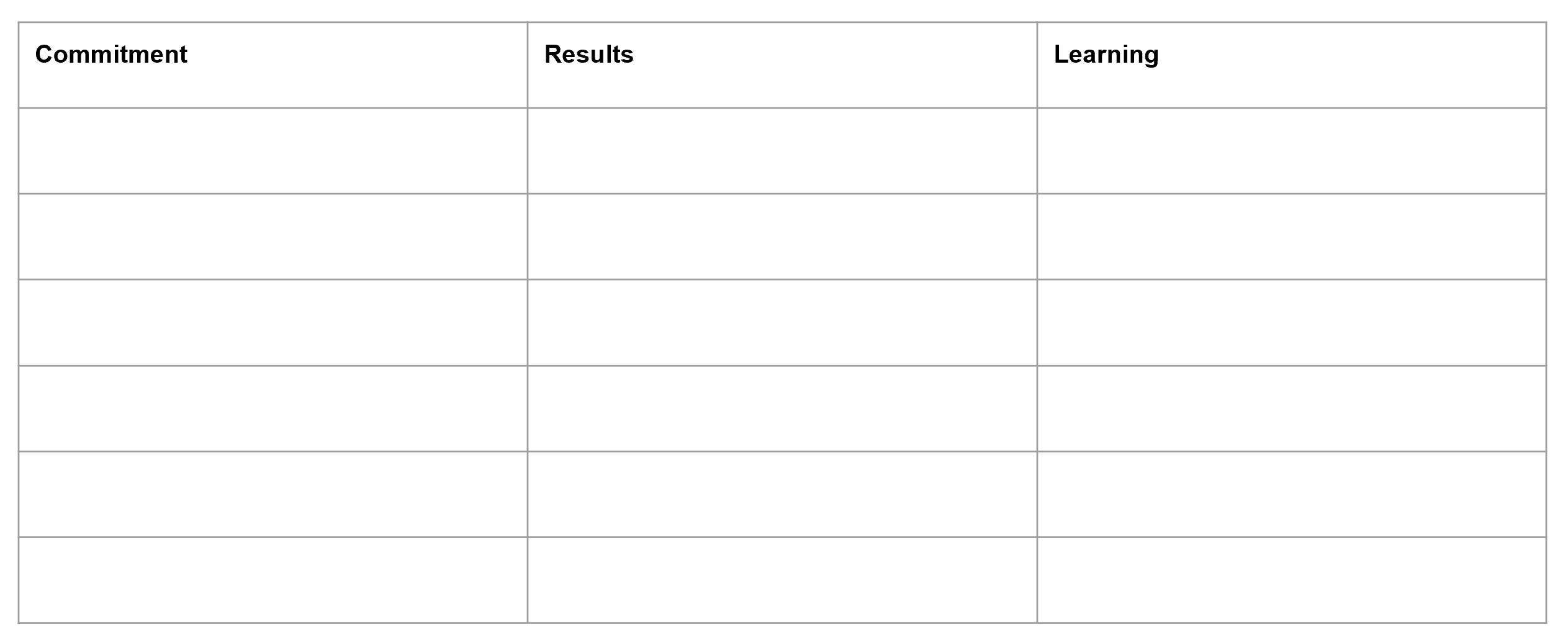
You divide a page into 3 columns:
- Column 1 is a commitment.
- Column number 2 is the result.
- Column number 3 is the learning.
You want to review your performance by saying hey, you said you were going to do these five things.
What is the commitment that you made, what is the result that you got, and what is the learning from all of it?
This way you’ll change your behavior better and plan your future better from real and actual learning and insights.
Why review your performance?
Here’s how Sharran puts it:
“Alright, let’s talk about part number 2, which is to review your performance.
I think it’s very hard to create for the future, without revieiwng the past.
People jump into these planning meetings, and they always think about the future, what should they do next.
But they don’t realize all the lessons that they could have learned from what they have already done or lack thereof in the past, because it gives them this context.
We will learn more from revieiwing our performnance than we will from planning for the future.
And reviewing our performance will give us the sense of why we did what we did, why we accomplished what we accomplished, and why something did not work, so that we can take that learning, and do something with it in the future.”
Reviewing Your Performance is Where Real Learning Comes From
When you step into your performance, and don’t lie to yourself, when you really own your behavior and results, you can create new clarity and insight into your productivity and performance.
The key to personal productivity is self-awareness.
Sharran shares an example:
“Right, this is where the real, the real feeling comes out.
I was talking to the CEO that I mentor, and after we did this exercise, he says, I want to create it where working harder comes easier.
Think about that great phrase.
I want to create a situation where working harder comes easier.
Working harder comes easier.”
Example #1 of Reviewing Your Performance
Sharran walks through an example where you’re commitment was to post a daily reel on Instagram:
- What was your commitment? Post a daily reel on Instagram.
- What was the result? The result was you posted it 50 percent of the time.
- What was the learning? The learning is well, the posting takes too much time. You’re too conscious on camera. The topics are hard to decide.
Turning your insight into action:
What you have to do to do the next version of this is you have to make the posting easier,
You have to be less conscious on camera, and you have to make the topics easier to do.
Because if you did that, you should technically, theoretically, consciously be able to create more content.
Example #2 of Reviewing Your Performance
Sharran walks through an example where the commitment was to save $10,000 this quarter:
- What was your commitment? Save $10,000 this quarter.
- What was the result? The result was you saved $3,000.
- What was the learning? You didn’t have an automatic saving plan. The goal may have been too high. You didn’t budget properly because you actually needed more expenses on a day-to-day basis.
Sharran says if you ask what was the learning, but come up with something like “Well the deals didn’t come through,” that’s not a learning, keep going.
You need to find something that you can control and change to act on.
From Zone of Resentment to Zone of Genius
You want to mind your learning so you can move away from your Zone of Resentment to your Zone of Genius.
Sharran puts it like this:
“The road to the zone of resenment is when you do something that you know how to do, but you know you should not be doing.
That’s when you get really irritated and you get really resentful.
Instead, we want to work in our zone of genius.
And working in your zone of genius, means that you work harder, and that comes easier.
And it’s really, really powerful because the zone of genius, the things we do are fascinating and motivating.
But the zone of resentment is something that you know how to do, but you know you should not be doing.
And that gets really, really frustrating.
The reason we review our performance is to really review the learning and figure out how much of our time is being spent in the zone of genius, and how much of our time is being spent in the zone of resentment.”
Mine Your Learnings So You Set Much Better Goals
If you don’t review your history, you repeat it, or make it worse.
Sharran shares how mining your learnings changes how you set goals.
“Once you review your performance and you set goals for the future, you will start setting a much better goal.
You’ll start designing a much better future.
You’ll start not saying oh, instead of waking up at 5 AM, now I’m going to wake up at 4 AM, like that doesn’t make any sense.
If you were not able to wake up at 5, why would you wake up at 4?
If you’re not able to hit a $10,000 savings goal, how are you gonna hit a $20,000 savings goal?
Right?
Unless you mine the learnings.”
Step #3. Design Your Future (4 Minutes)
In this step, you design your future. To do this, you pick a time frame (If you’re unsure you pick a quarter), focus on 4-8 initiatives max, and you create a grid.
The grid has got these 4 things: commitment, rationale, KPIs, and action and distraction.
Here’s an example of the structure:
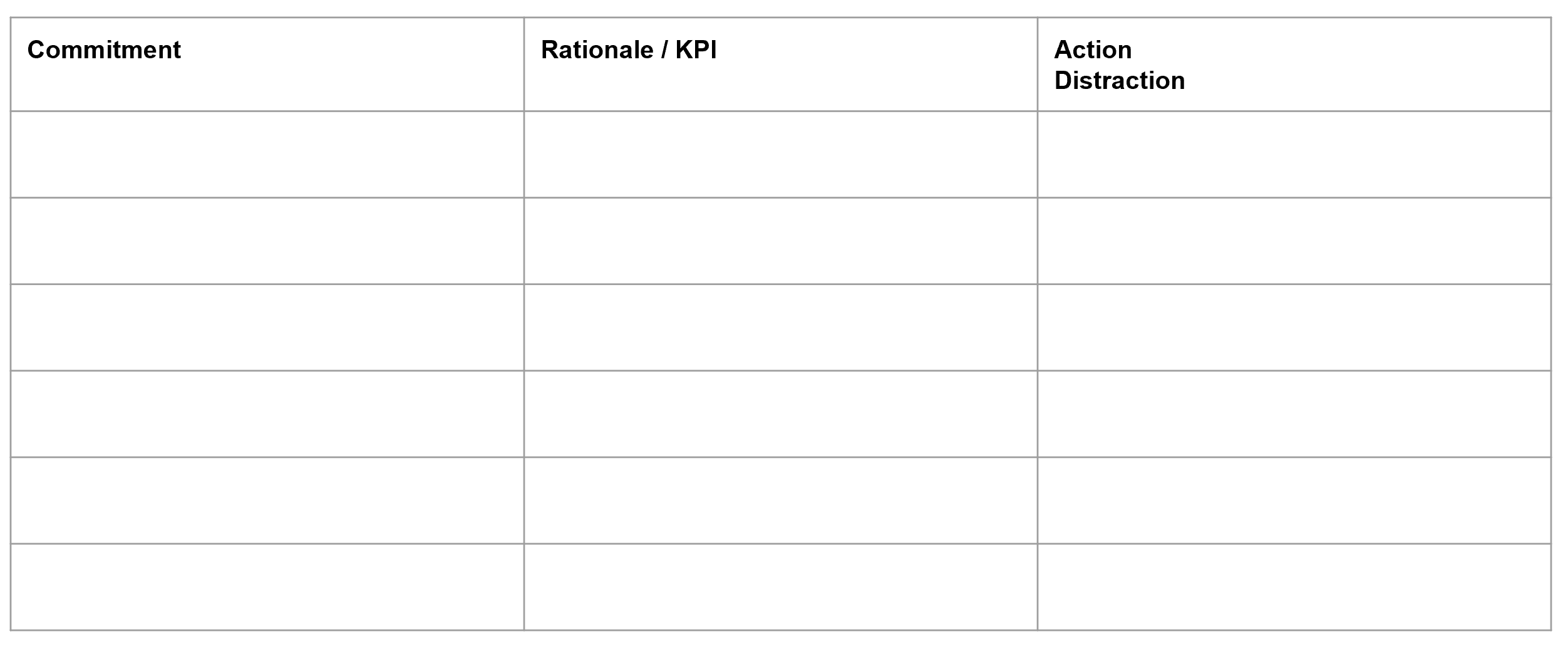
You create a simple 3-column grid:
- Column number one is the commitment that you’re making.
- Column number two is the rationale as to why you’re making that commitment and the KPI as to how would you know if you actually hit that commitment or not.
- Column number 3 is what excuses or distractions that can come up that you’re going to call out right now?
Example of Commitment, Rationale, Key KPI, Actions and Distractions
Mapping your commitments to the table might take a little bit of thinking through it.
But the value will be that you set yourself up for more consistent success.
Sharran shares an example:
- Commitment: Commitment is to make an extra $100,000 dollars in sales.
- Rationale: Rationale is we’re saving for college.
- KPI: KPI is $100,000 in sales.
- Actions: And the action is 3 extra times in prospecting.
- Distraction: The distraction is you don’t know exactly what to say or don’t know who to call.
So now we know if you know exactly what to say, or know who you need to call, your brain automatically knows that there’s no more distractions, therefore, your ability to take the action becomes significantly easier.
Why a Quarter is Often a Good Timeframe
Sharran recommends starting with a quarter, or 90 days, if you don’t know where to start.
I like this recommendation simply because I know how 90 days is a great time frame for meaningful execution.
Leaders are used to showing quarterly results.
And people are used to trying 90 day transformations.
A month can work, too, but it can also be too tight a time frame to make meaningful progress.
Sharran shares why a quarter is often a good timeframe:
“How I like to do it is to, when you say we’re going to design the future, you want to pick a time frame. You want to pick a time frame that is long enough to achieve something substantial, and short enough where, it doesn’t feel like it’s taking forever.
So I’ll give you a simple example.
Um, long enough to achieve something meaningful.
So a week is not long enough to achieve something meaningful.
But it’s definitely short enough to not feel like it’s taking forever.
A year, is definitely meaningful, and long enough to achieve something, but it’s not short enough to get here pretty quickly.
So I would offer you’re somewhere in the 10 weeks to a quater range, because it’s long enough to achieve something in an 8 to 12 week period, but it’s short enough to know that it will get there soon enough so that you can review your performance again.
Picking a timeframe is really important.
If you don’t know or can’t figure one out, I would just offer do it on a quarterly basis, because there’s some form of cyclical nature to most businesses that work in quarters.
And so think about the quarter and think about how things work and say hey, pick a timeframe to design the future.”
How To Think About This Step as Your Gamechanger
When you are adding these commitments, they go beyond what you are already doing.
You already have your daily routines and habits and tasks and workload.
This is about doing your workload better and doing things different so you can achieve more of what you want.
Here’s what Sharran says:
“So, let’s say we’re picking a 90-day goal.
Second, I would do no more than 4 to 8 max initiatives.
Remember this, you already have your day-to-day quote job, day to day responsibilities, day to day things that you’re already committed to.
All these planning initiatives are probably either going to be connected to those, or a little bit more than those, because you probably want to do better.
You’re planning.
Think about this for a second. You’re planning to do better than what you’re already doing. Therefore, if you only commit to doing what you’re already doing it’s not going to get any better.
Right?
Most people that don’t want to get any better, will just keep doing what they’re already doing.
So, they keep doing what they’re already doing.
And everything stays the same.
No wonder of course.
Of course, it’s going to be that way.
Right?
But if you want to get better, we gotta continue what we’re already doing, and do a little bit more.
This is to design the future for doing a little bit more.”
Make It Happen: Schedule a 15-Minute Project with Yourself
Schedule a 15-minute project with yourself to do the 12-Minute CEO Planner.
Give yourself some breathing room, but don’t stretch it out.
It’s better you do it fast and focused, and then try it again, if you need to, than to turn it into a heavy exercise.
You want to practice it and build this muscle so that it’s easy to do, fun to do, and always rewarding, even if it’s a challenging exercise for you.
Sharran recaps the 12-Minute CEO Planner exercise like this:
“Number one, you want some kind of organized brainstorm. Organize the brainstorm, it’s like taking all the jigsaw pieces, putting it on the table, so you can start to see the pieces, that you have so you can build a life that you want.
Number two, review for learnings. You gotta review the performance. The three pieces you need are what is the commitment, what is the result, and what’s the learning, because when you review the learning, it allows you to work harder, while making it all easier. Which is great.
Number three, you gotta design the future. Design the future has a got a lot: picking the time frame for the initiatives, and making sure you understand the commitment, the rationale, the KPIs and the action, and distraction.
My suggestion would be just schedule a 15-minute project. Schedule a 15-minute project to just go through this, it will take you 12, 15 minutes max. If you have the worksheets, and once you have the worksheets, it makes it really, really, really easy overall.”
Where to Go for More?
Sharran shares a great walkthrough of his 12-Minute CEO Planner:
Episode 157: The 12-Minute CEO Planner – Sharran Srivatsaa
In the episode, Sharran includes a way to get his templates, too.
You Might Also Like
10 Big Ideas from Agile Results
What Are SMART Goals: The Definitive Guide
How To Be Strategic with Your Goals
How To Use OKRs with Agile Results
How To Use the Four Tendencies to Achieve Goals

 The Fun Factor
